
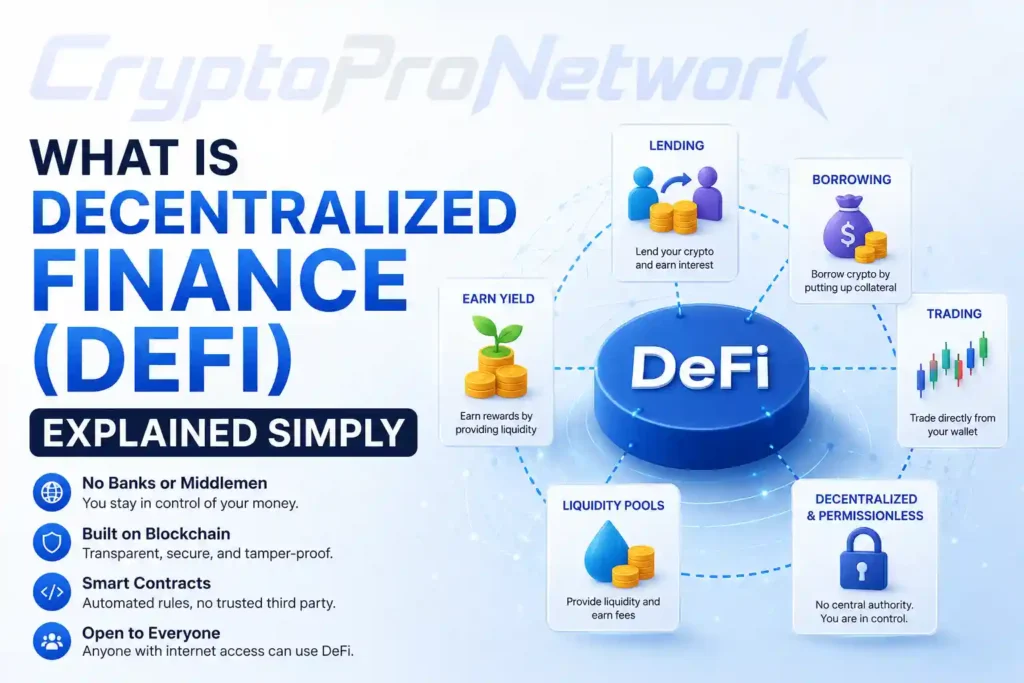
What is decentralized finance explained simply is a question a lot of people start asking once they get curious about cryptocurrency and notice the term DeFi popping up everywhere. It sounds technical at first, but the core idea behind decentralized finance is actually easier to grasp than it seems once it is broken down without the jargon. This guide explains what decentralized finance really means, how it works, and why so many people believe it could change the way financial services operate.
What Is Decentralized Finance
Decentralized finance, usually shortened to DeFi, refers to financial services like lending, borrowing, trading, and saving that operate without relying on a traditional middleman such as a bank or financial institution. Instead of a bank approving a loan or a broker handling a trade, these tasks are carried out through code, specifically through programs called smart contracts that run on a blockchain.
In simple terms, DeFi tries to recreate the financial system we already know, borrowing money, earning interest, trading assets, but without needing a central company or authority controlling the process.
How Traditional Finance Is Different From DeFi
To understand DeFi properly, it helps to compare it with how traditional finance works. If you want to take out a loan from a bank, the bank checks your credit history, decides whether to approve you, sets the terms, and controls the entire process. You are trusting that institution to handle your money and follow through on its end of the agreement.
In decentralized finance, that same loan can happen directly between two people, or more accurately, between a person and a smart contract, without a bank ever getting involved. The rules of the loan, such as interest rates and repayment terms, are written directly into code, and the smart contract automatically enforces those rules without needing a human to approve or manage anything.
What Are Smart Contracts
Smart contracts are one of the most important building blocks of decentralized finance, so understanding them makes the rest of DeFi much easier to follow. A smart contract is simply a program stored on a blockchain that automatically executes an action once certain conditions are met.
For example, a smart contract could be programmed to automatically release funds to a lender once a borrower repays a loan, without either party needing to trust the other directly. Instead, both sides trust the code, which runs exactly as written and cannot be changed once it is deployed, at least not without going through a very transparent and often difficult process.
Common Things People Do With DeFi
Decentralized finance covers a fairly wide range of financial activities, many of which mirror what traditional banks and financial platforms already offer.
Lending and borrowing platforms allow people to lend out their cryptocurrency to earn interest, or borrow funds by putting up other cryptocurrency as collateral. Decentralized exchanges let people trade one cryptocurrency for another directly, without needing a centralized company to manage the trade. Yield farming and staking allow people to earn rewards by locking up their crypto assets to help support the network or a specific platform. Stablecoins, which are cryptocurrencies designed to hold a steady value, often tied to a currency like the US dollar, are also heavily used within DeFi to avoid the extreme price swings common in other cryptocurrencies.
Why People Are Interested In DeFi
A big part of the appeal behind decentralized finance comes down to accessibility and control. Traditional financial systems often require paperwork, credit checks, and approval processes that can exclude people who do not have access to traditional banking, particularly in regions where banking infrastructure is limited.
DeFi platforms are generally open to anyone with an internet connection and a cryptocurrency wallet, without needing approval from a central authority. This has made it appealing to people who want more direct control over their money, without relying on a bank to hold or manage it on their behalf.
The Risks That Come With DeFi
While decentralized finance offers some real advantages, it also comes with risks that beginners should understand clearly before getting involved.
Smart contracts, despite being automated, are still written by humans, which means they can contain bugs or vulnerabilities that hackers sometimes exploit. Unlike a bank, there is usually no customer support to call and no guaranteed way to recover lost funds if something goes wrong. The value of cryptocurrencies used within DeFi can also be highly volatile, meaning the value of collateral or holdings can change dramatically in a short period of time.
Regulation around DeFi is also still developing in many countries, which adds a layer of uncertainty that does not exist in the same way with traditional, heavily regulated financial institutions.
Is DeFi Safe For Beginners
DeFi is not inherently unsafe, but it does require a much more hands on and cautious approach compared to traditional banking, where a lot of the underlying risk is managed by regulated institutions on the user’s behalf. Beginners exploring DeFi are usually better off starting with small amounts, sticking to well established and widely used platforms, and taking the time to understand exactly how a specific service works before committing significant funds to it.
Doing basic research into a platform’s history, security audits, and community reputation before using it is one of the simplest ways to reduce unnecessary risk.
Conclusion
Decentralized finance is essentially an attempt to rebuild familiar financial services, lending, borrowing, trading, and earning interest, using blockchain technology instead of traditional institutions as the middleman. It offers more direct control and open access, but it also shifts a lot of responsibility onto the individual user, since there is no central authority to fall back on if something goes wrong.
For beginners, the best approach is to treat DeFi as a space worth understanding gradually rather than jumping in with significant funds right away. Learning how it works, starting small, and staying cautious goes a long way in navigating this still evolving corner of the financial world.
Frequently Asked Questions
Is DeFi the same as cryptocurrency?
Not exactly. Cryptocurrency is the digital asset itself, while DeFi refers to financial services, like lending and trading, built using blockchain and cryptocurrency.
Do I need a bank account to use DeFi?
No. DeFi platforms are generally accessed through a cryptocurrency wallet and an internet connection, without requiring a traditional bank account.
Is DeFi regulated like traditional banks?
Not in the same way. Regulation around DeFi varies by country and is still developing in many regions, which adds a level of uncertainty compared to traditional finance.
Can I lose money using DeFi platforms?
Yes. Risks include smart contract vulnerabilities, market volatility, and the lack of guaranteed recovery options if something goes wrong, so caution is important.
Is DeFi a good option for complete beginners?
It can be, but beginners should start small, use well established platforms, and take time to understand how a service works before committing significant funds.
Also read: How To Start Crypto Trading For Beginners